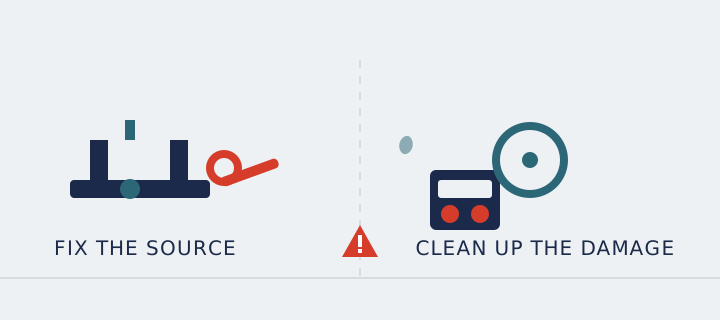
A plumber fixes the source: the broken pipe, failed valve, or worn fitting that's letting water out in the first place. A water damage restoration crew fixes the aftermath: extracting standing water and drying out the drywall, flooring, and subfloor before mold has a chance to start. Most burst-pipe or leak situations need both, and they're usually two separate calls, since plumbing repair and water damage restoration are different trades with different licensing. If water is actively leaking right now, shut it off at the main or local valve if you safely can, then call a restoration crew immediately to start drying — every hour standing water sits adds to the damage. Call a plumber separately to actually repair what broke.
Two Different Jobs, Not One
It's an easy mix-up, because both calls usually happen the same day and both feel like part of "fixing the water problem." But they're doing different work. A plumber's job is the pipe, fixture, or fitting itself — cutting out a burst section of copper, replacing a failed supply line, repairing a water heater, or clearing a clogged drain. A restoration crew's job is everything the water touched after it got out: extracting standing water, running air movers and dehumidifiers to dry framing and subfloor, and preventing the mold growth that can start within 24 to 48 hours in the right conditions. One stops the bleeding. The other treats the wound.
Some companies do offer both plumbing and restoration services under one roof, but that's not the norm you should assume. Plumbing repair requires a licensed plumber. Water damage restoration is built around a different standard entirely — the IICRC S500 water damage restoration standard — with its own certifications (like WRT, Water Damage Restoration Technician) that have nothing to do with plumbing licensure. If a company offers both, ask directly whether the same crew handles it or whether it's two different teams; don't assume one call covers everything.
What Happens If You Only Call One
Only the plumber: the leak gets fixed, which matters, but the water that already soaked into your drywall, flooring, and subfloor doesn't go anywhere on its own. Left alone, it can take weeks to dry naturally, and by then mold has had plenty of time to start. A plumber generally isn't equipped with commercial-grade extraction and drying equipment, and fixing the leak was never their job description in the first place.
Only the restoration crew: the standing water gets extracted and the space gets dried out properly, but if the pipe, valve, or fitting that actually failed never gets repaired, you're likely to have the same problem again, sometimes within days. A restoration crew's job is the damage, not the plumbing system that caused it.
When It's Just a Plumber (No Restoration Needed)
Not every plumbing problem is a water damage problem. A dripping faucet, a running toilet, or a leak caught and stopped within minutes with no standing water and nothing visibly soaked usually just needs a plumber. The general rule of thumb: if water sat for more than a few minutes on flooring, soaked into a wall, or you're not fully sure how far it traveled (behind cabinets, under flooring, inside a wall cavity), it's worth at least a quick assessment from a restoration crew, even if the visible damage looks small.
When It's Both — And Why the Order Matters
For an actual burst pipe, active supply line failure, or water heater rupture, you're almost always looking at both calls. Sequence matters more than most homeowners expect:
- Shut off the water first, at the main shutoff or a local valve, if it's safe to reach. This stops new damage from happening while you make calls.
- Call the restoration crew before the plumbing repair is even scheduled. Every hour water sits raises the cost and the mold risk, and drying can start before the pipe itself is fixed, as long as the water source is off.
- Call a plumber separately to repair or replace whatever actually failed, so the same damage doesn't happen again.
See ClearFlow's guide on what to do when a pipe bursts for the fuller first-hour checklist, including how to find your main shutoff before you ever need it.
Does ClearFlow Connect You to a Plumber?
No. ClearFlow's dispatch line connects callers to licensed, IICRC-certified water damage restoration crews, not plumbers. If your water is still actively leaking and hasn't been stopped, you'll need to call a plumber (or your local water utility, if it's a main break outside the home) separately to handle the repair itself. ClearFlow's line is specifically for what comes after the water is out: extraction, drying, and getting your home back in order.
If water damage has already happened, anywhere in Ohio, ClearFlow Restoration's dispatch line connects you to a licensed, IICRC-certified restoration crew, 24/7, to start extraction and drying right away.
📞 Call (419) 588-0112Frequently Asked Questions
Do I call a plumber or a restoration company first when a pipe bursts?
Whichever you can reach fastest, but the water damage clock is usually the bigger risk. If you can shut off the water yourself at the main or a local valve, do that immediately, then call a restoration crew to start extraction and drying right away. Call a plumber separately to actually repair the broken pipe, fixture, or fitting.
Can the same company do both the plumbing repair and the water damage cleanup?
Sometimes, but they're licensed differently and it's not guaranteed. Plumbing repair requires a licensed plumber. Water damage restoration is a separate trade built around extraction, drying, and IICRC S500 procedures. Some companies offer both under one roof; many don't, and it's worth asking directly rather than assuming.
What happens if I only call a plumber and skip the restoration crew?
The leak gets fixed, but the water that already got into your drywall, flooring, and subfloor doesn't go anywhere on its own. Left to dry naturally, it can take weeks, and mold can begin developing within 24 to 48 hours in the right conditions. A plumber stops new water from coming in; they generally don't extract or dry out what's already there.
What happens if I only call a restoration crew and skip the plumber?
A restoration crew can extract standing water and start drying, but if the actual source of the leak, a broken pipe, failed valve, or worn-out fitting, is never repaired, the water damage will most likely happen again. Restoration crews clean up damage; they generally don't perform licensed plumbing repairs to the fixture or pipe itself.
Does ClearFlow's dispatch line connect me to a plumber?
No. ClearFlow's dispatch line connects callers to licensed, IICRC-certified water damage restoration crews, not plumbers. If the leak is still active and hasn't been stopped, you'll still need to call a plumber (or your water utility, for a main break) separately to repair the source.