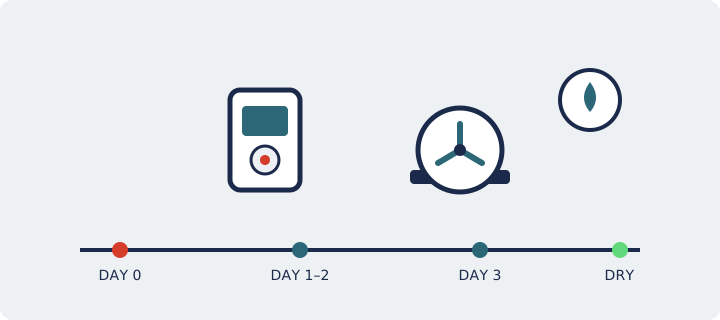
The EPA's guidance on mold and moisture is specific: in most cases, mold won't grow if wet materials are dried within 24 to 48 hours of water exposure. After a flood, that means getting standing water out immediately, running air movers and dehumidifiers continuously (not on and off) for the next one to three days, removing porous materials like wet carpet padding and insulation that can't dry fast enough on their own, and keeping indoor humidity below 60%, ideally between 30 and 50%. This is about preventing mold before it starts, which is a different job than remediating mold that's already established — if you're past that point, the timeline and approach are different.
Day 0: Get the Water Out
The clock starts the moment water enters the home, not when you notice it. Standing water needs to be extracted as fast as possible — a wet vac for a small amount, a pump for anything deeper, or professional extraction equipment for a flood-scale event. Every hour water sits is an hour closer to the 24-to-48-hour window the EPA identifies as the point past which mold becomes likely rather than avoidable. If you're dealing with floodwater specifically, treat it as contaminated (Category 2 or 3) rather than clean water, since floodwater picks up whatever it traveled through on the way into your home.
Day 1 to 2: Remove What Can't Dry Fast Enough
Some materials simply won't dry within the safe window no matter how much airflow you throw at them, and trying anyway just delays the inevitable while giving mold more time. Wet carpet padding, water-logged insulation, and drywall that was submerged below the waterline typically need to come out rather than be dried in place. If wall cavities have wet insulation inside them, opening the wall is usually necessary to get air moving through the space, not just across the surface. This is also the point where personal protective equipment matters most if the water was contaminated, since removing saturated porous material stirs up whatever was in that water.
This is also when air movers and dehumidifiers need to be running continuously, not cycled on and off to save on electricity. Continuous airflow is what actually pulls moisture out of studs, subfloor, and other structural materials, not just the visible surface, which is the difference between materials that look dry and materials that measure dry.
Day 3: Verify With a Moisture Meter, Not a Guess
Surface-dry is not the same as actually dry. By day three, moisture readings inside wall cavities and subfloor, taken with an actual moisture meter, should start confirming whether the structure is approaching a safe level or still holding water that isn't visible. This is the point in the process where guessing costs you later — materials that feel dry to the touch can still be wet enough several inches in to support mold growth weeks after the visible cleanup looks finished.
Keep Humidity Below 60%, and Ideally Under 50%
The EPA specifically recommends keeping indoor humidity below 60%, ideally in the 30 to 50% range, and an inexpensive hygrometer tells you where your home actually sits rather than leaving it to a guess. Running dehumidifiers isn't just about drying the directly affected area — elevated whole-home humidity after a flood event can create conditions for mold to start in rooms the water never even reached.
| Timeframe | What Should Be Happening |
|---|---|
| Day 0 | Standing water extracted immediately |
| Day 1–2 | Non-salvageable porous materials removed; air movers and dehumidifiers running continuously |
| Day 3 | Moisture meter readings confirm wall cavities and subfloor are actually drying, not just the surface |
| Ongoing | Indoor humidity held below 60%, ideally 30–50% |
When to Stop Trying to Handle It Yourself
A small, contained, clean-water spill that you catch and dry within a day is a reasonable DIY job. Anything beyond that changes the math. If water has already been sitting more than 24 to 48 hours, if it's floodwater rather than a clean leak (which covers essentially all flooding, since it's picked up contaminants on the way in), or if the affected area covers more than a small, contained spot, professional extraction and drying is both the safer and typically the faster path, for your health and for your home. See ClearFlow's guide on Category 3 black water damage for what changes when the water itself is contaminated, not just the timeline.
This Isn't the Same as Mold Remediation
Everything above is about preventing mold from establishing itself in the first place. If mold has already grown — visible colonies, a persistent musty smell that doesn't resolve, or a professional inspection confirming it — the process changes to remediation, which follows a different and typically longer timeline. See ClearFlow's guide on how long mold remediation actually takes if that's the situation you're already in, or whether mold in a basement is actually dangerous to understand the health stakes either way.
Dealing with flood damage right now and racing the clock on drying? ClearFlow Restoration's dispatch line connects you to a licensed, IICRC-certified crew serving your part of Ohio, 24/7.
📞 Call (419) 588-0112Frequently Asked Questions
How long do I have to dry out a flooded home before mold starts?
The EPA's guidance on mold and moisture states that in most cases, mold will not grow if wet materials are dried within 24 to 48 hours of a leak or flood. That window is the target, not a guarantee — the faster you get water out and air moving, the better your odds.
What humidity level actually prevents mold from growing?
The EPA recommends keeping indoor humidity below 60 percent, ideally between 30 and 50 percent. An inexpensive hygrometer can tell you where your home actually sits, rather than guessing.
Should I remove wet carpet padding and insulation myself?
Wet carpet padding and insulation are porous materials that rarely dry fast enough to avoid mold, and removing them is standard practice rather than trying to dry them in place. If the water is contaminated (Category 2 or 3, which includes essentially all floodwater), this removal work involves health risks that are better handled by a professional crew with the right protective equipment.
When should I stop trying to dry it out myself and call a professional?
If water has been sitting for more than 24 to 48 hours, if it's contaminated floodwater rather than a clean water leak, or if the affected area is larger than a small, contained spot, professional extraction and drying is the safer and typically faster path, both for your health and for your home.
Is this the same as mold remediation?
No. This guide covers what to do in the first several days after flooding to prevent mold from ever taking hold. If mold has already established itself, the process is different and typically takes longer — see ClearFlow's guide on how long mold remediation actually takes for that situation instead.